

How Much Do Girls Waist On Makeup Statistics
The feminine dazzler ideal is a specific gear up of beauty standards regarding traits that are ingrained in women throughout their lives and from a young historic period to increase their perceived physical attractiveness. It is a phenomenon experienced past many women in the world, though the traits change over time and vary in country and culture.[1]
Feminine beauty ideals are mainly rooted in heteronormative beliefs, but they heavily influence women of all sexual orientations. The feminine dazzler platonic traits include but are not limited to: female body shape, facial feature, peel tones, height, clothing style, hairstyle and body weight. In guild to emulate said desirable traits, women accept called to undergo facial and body-altering practices which range in severity. Some of these practices include: plastic surgery, skin bleaching, human foot bounden, neck rings, hair removal, makeup, wig installations, teeth lacquering, tanning, corestry, etc.
With the influence of fairy tales, mass media, and advertisements, fashion and beauty-centred dolls such as Barbie dolls and female characters in fairy tales playing a prominent role in many women's lives, it adds to the pressure to arrange to the feminine dazzler ideal starting from a young age. Treatment the pressure to conform to a certain definition of "beautiful" tin have psychological effects on an private, such as low, eating disorders, body dysmorphia and depression self-esteem, starting from an boyish age and continuing into adulthood.
From an evolutionary perspective, some perceptions of feminine beauty ideals correlate with fertility and health.
Across cultures [edit]
General [edit]

There have been many ideas over fourth dimension and across unlike cultures of what the feminine beauty ideal is for a woman'south body image. How well a woman follows these beauty ethics can too influence her social condition within her civilization. Physically altering the body has been a custom in many areas of the world for a long time.
In Myanmar, Kayan Lahwi girls from the age of near 5 years have metal rings put around their necks. Additional rings are added to the girl's cervix every two years. This practice is done to produce a giraffe-similar effect in women past gradually deforming the clavicles and placement of the ribs through the weight of the rings to create the impression of a longer neck. This practise is dying out,[ citation needed ] but these women would somewhen carry up to 24 rings around their necks. A neck with many rings was considered the "ideal" image of physical beauty in this civilization.
The practice of human foot bounden in China involved a girl'southward feet being bound at age six to create the "ideal" epitome of anxiety. The girl's feet were bound to get one/three the original size, which crippled the adult female, but also gave her a very high social status and was much admired. After the revolution of 1911, this do of pes binding was concluded. The idea of what is considered the platonic of dazzler for women varies across different cultural ethics and practices.[two]
The exercise of skin whitening is common amid women in Southeast Asia and Africa. In modern times, fitting the now-widespread Eurocentric dazzler standard confers greater privileges in many Southeast Asian and African societies, but the preference for low-cal skin in Asia is really not a result of European colonialism and has instead been a role of society since long before any contact. These beauty standards have also resulted in the cosmos of pare whitening and bleaching industries in Asian and African countries, including Ghana.[three] Discrimination based on skin colour, besides referred to equally colourism, has been described past scholars as being conceptualized by deeming lighter-skinned individuals as superior in terms of beauty and responsibleness compared to their darker-skinned counterparts. Favouritism based on colourism in terms of social and economical distributions of power was based on systems implemented during the colonisation of Africa by European powers, which established Eurocentric beauty standards.[3]
East Asian women [edit]
People's republic of china [edit]
In People's republic of china, similar to South korea, pale skin is seen every bit desirable. A archetype folk saying originated from Zhang Dai, "一白遮百丑" , literally translates to "pale skin covers a hundred flaws".
Historically, Tang Dynasty women with a plump effigy were considered the standardized view of beauty, contrasting with the expectations of tall, slim figures of today.[4]
Starting from Vocal elitists and somewhen popularized and concluded in Qing dynasty, foot bounden was seen as an idolized representation of women'southward petite beauty, referring to the practice as "三寸金莲" , '3 inch golden lotus'.
Dazzler is often used equally a popular bailiwick in Chinese literature and poetry. Historically, beauty did not necessarily relate solely to the appearance of a person's figure, and the criteria of being beautiful stretched beyond looks. An example of this would exist the association of nobility with dazzler and being poor or of peasant condition with existence ugly. Famous Chinese beauties portrayed in historical literature virtually always come up from a noble or middle-form status, and depictions often portray them as court ladies or servants of court ladies, garbed with glamorous feminine clothing to represent their identity. Women that did not fit the social condition necessary to vesture such clothing, such as commoners, were eliminated in terms of depictions of beautiful women.[4]
Nihon [edit]
Though sharing some aspects of Confucian culture with Prc, beauty standards between Cathay and Nihon have differed historically. Dating back to the Heian period (794–1185), Japanese court ladies would colour the teeth black (a practice known as ohaguro ) upon reaching adulthood. This custom was adept by the nobility, samurai clans and could be seen at a large number of temples,[ citation needed ] but was not mostly seen among commoners. The practice of teeth blackening lasted until the Meiji Restoration (1868).[ citation needed ]
Hairdressing and apparel were of supreme importance in the Heian catamenia; eyebrows were plucked and replaced with darker, wider ones painted college on the brow, a practice known as hikimayu . Hair had to be at least long enough to touch the ground when seated. The apply of pale makeup known equally oshiroi was common, which emphasized the colour combinations of Heian-menses clothing - jūnihitoe for women and suikan for men - which were chosen for their seasonality and symbolism.

Celebrated Geysha of Tokyo (published by Ogawa Kazumasa in Kanda-ward, Tokyo, Japan, June 25, 1895)
Scholar and art critic Okakura Kakuzō delivered in his compilations of lectures in 1905, that the considerable bases of dazzler for modern Japan is:
...to make a cute women, She is to possess a body not much exceeding 5 anxiety in height, with comparatively off-white skin and proportionally well-developed limbs; a head covered with long, thick, and jet-black hair; an oval face with a straight nose, high and narrow; rather big eyes, with big deep-brown pupils and thick eyelashes, a pocket-size mouth, hiding behind its red, but not sparse lips, even rows of small white teeth; ears not altogether small; and long thick eyebrows forming two horizontal but slightly curved lines, with a infinite left between them and the eyes...a very high as well equally a very low brow existence considered not attractive.[ citation needed ]
More than recently, it has been found that in one of Japan'southward youth beauty subcultures, the focus is on the concept of parody and mimicry of Japanese manga and anime characters.[5] Japanese youth in this beauty subculture try to mimic manga and anime characters past mimicking the same hair colour with the use of hair dye or wigs that are in colours such as blueish, majestic, red, pink, blonde and brown.[6] To attain drawing-like optics, individuals opt for contact lenses that are variegated brown, pinkish, argent and aureate, with iris enlargement features.[6]
Another Japanese dazzler subculture is rooted in mail-modernism.[7] This dazzler subculture advocates more anti-aesthetics, incomplete, uncertainty, pluralism, and deconstruction of what is considered to be 'beautiful' which is confronting the normal Japanese beauty standard which was based on aesthetics.[viii] This is assuasive Japanese women to encompass their 'flaws' that society used to plough against them and to instead use their features and encompass the uniqueness of ane's moles, birthmarks, eye shape, teeth shape and various facial elements.[7]
Korea [edit]
South korea is known for its frequently stringent beauty standards, which have resulted in the notable development of the Korean skincare industry.[9] South Korean dazzler standards are defined past a "very pale pare, large eyes with double eyelids, a tiny nose with a loftier nose bridge, and rosebud lips", a small confront and subtly-pointed chin.[10] As these standards are difficult to reach, cosmetic surgery has go in Due south Korea; equally of 2018[update], it had highest charge per unit of cosmetic surgery per capita, a figure predicted to increment in later on years.[xi]
Between 1990 and 2006, the number of surgeries specializing in plastic surgery in South Korea grew to the total rate of 8.9 percent per year, where the bulk fraction undergoing these procedures were immature people. A survey in 2004 showed that out of 1,565 female students attending college, 25.4 percent of them had undergone plastic surgery for double eyelids, 3.6 percent for olfactory organ, and 1 percentage for jaw/cheekbone.[12] Compared with the average 1 in xx women receiving plastic surgery in America,[ when? ] the boilerplate number of Korean women that have had plastic surgery is approximately one in 5.[13] [14] Due to the rise of idol culture, beauty aesthetics in Due south Korea have undergone desperate changes, where women relate beauty with professional success. In workplaces, women are expected to be physical attractive; headshots are required when submitting resumes to some companies, and the appearance of female applicants is ofttimes scrutinized, with professional skill and physical dazzler idealized.[thirteen] [14]
In addition to idol culture, researchers have found that due to Republic of korea'southward hypercompetitive society, Korean women accept gradually come to believe that they could achieve more than from superior dazzler fifty-fifty though they may have a limited amount of social resource.[seven] In a inquiry written report done, it was found that Korean women associated beauty with having an easier time searching for jobs, finding spouses and college income levels.[seven] In that location is also a concept called the halo effect in Korea, where being beautiful and beingness smart leads to the ultimate level of beauty. If a woman is considered to be smart, by attending a prestigious university like Seoul National Academy, and up to South korea'south strict beautiful standards, she is considered to exist "untouchable" and "no one can beat her".[7]
The latest 'activist'-similar movement that young girls in Southward Korea are promoting is called the "Pro-ana" motion, immature girls will go onto various websites and social media outlets to promote behaviours related to eating disorder anorexia,[xv] such equally how to throw away lunch at school without getting in trouble with the staff members at school and how to not become caught past parents. A majority of the girls who are involved in this movement are not eating properly and starving themselves until their weight drops to a frail amount of 30 to 40 kilograms. Individuals who are extremists about losing weight will take vast amounts of constipation pills to flush food out of their system quickly, equally the lack of nutrition will crusade them to lose weight drastically.[fifteen] On the rare occasions where girls will eat a proper meal, they feel guilty for indulging, so they will turn to bulimic tendencies and force themselves to vomit to maintain their thin shape.
In Korea, psychotropic appetite suppressants as well increased in popularity by 31.five percent from 93.2 billion won (United states$77.iv one thousand thousand) in 2014 to 122.v billion won (US$102.8 one thousand thousand) in 2018, while the sales in non-psychotropic ambition suppressants rose 126.8 percentage from 34.9 billion won (The states$29.3 million) to 79.1 billion won (U.s.$66 meg) during the aforementioned time.[15] The long-term use of psychotropic appetite suppressants increases the chance of side effects such as pulmonary hypertension and severe heart affliction. This, in combination with the lack of nutrients that girls receive due to anorexic tendencies can cause malnutrition, osteoporosis, heart disease and pilus loss.[fifteen] Taking into account that information technology is more harmful to teenagers equally their brains and bodies are still in development, their extreme dieting happens can lead to irregular menstruation, loss of period, stunted growth, and in extreme cases, death.[15]
The principal problem with girls who are active in the Pro-ana movement is that they themselves are not unaware of the risk of anorexia. They know that anorexia is a disease, but believe their actions are justified due to the civilisation that they live in, a civilisation that harshly criticizes the perceived beauty of individuals based on their body shape.
South asia [edit]
The idea of beauty standards in Southward Asia has had a long history with fair skin tone. The normative societal expectation of beauty of people has been associated with the gradient of their skin color. The fairer ane becomes, the more than bonny they are. Fairness is also a tool of belongingness and social acceptance within the dominant society. Whiteness is the almost ideal beauty standard of coloured women in Southern asia.[xvi]
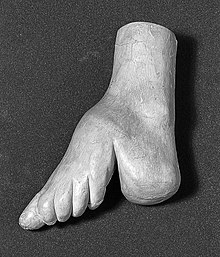
Bandage of women's foot plain-featured by foot binding
French women [edit]
There have been multiple dazzler ideals for women in France. Brântome lists as many as 30 things are needed to make a woman cute, A mutual but ridgid ideal might include supposed Brântome'south "three white things". These "things" or traits refer to skin, teeth, and hands. There are likewise the "three black things", including the color of the person'due south eyebrows and eyelashes. This leaves iii other areas to embark on, including the cheeks, lips, and nails. This beauty standard also was noted to pull from "sections on alchemy, medicine, astrology, cooking and the fine art of looking cute" [17]
Co-ordinate to Wandering Pioneer, beauty standards in France seem to business someone's style rather than the torso shape.[18] In add-on, the French approach to beauty is about enhancing natural features rather than achieving a specific look.[19] Co-ordinate to some dermatologists, looking immature is not a beauty criterion. Instead, women desire to look toned and their pare to await business firm.[20]
Blackness women [edit]
Black women in the U.s.a. accept the highest rates of being overweight or obese, likewise as the highest Body Mass Index (BMI) levels.[21] Despite this conflicting with the dominant thin beauty platonic, studies take plant black women to exist more often than not more tolerant of heavier trunk weights compared to women of other groups, and black women additionally frequently underestimate the size of their own bodies.[22] A curvaceous physique consisting of very large buttocks, hips, and thighs is ofttimes perceived by black women to exist highly attractive and desirable.[23] [24] Curvier bodies are too seen as attractive in the Caribbean, and they are known equally the "Coca-cola bottle" body.[24] However, curvier bodies result in unique scrutiny for black women, such equally the 19th century case of Sarah Baartman, who was exhibited in freak show attractions across Europe due to the size of her large buttocks, which were seen as a sign of her racial inferiority.[25] While the curvy body blazon oft subjects black women to negative stigma, it is often deemed trendy on non-black women.[26] Eurocentric features are near desired and socially accepted. Eurocentric dazzler paradigms not only often exclude black women (their cultural attire, natural hair types, different skin colours, or various body types), but they also impact blackness women's identity. One study indicated that women with lighter skin tones, long, softer hair, and have Eurocentric facial features not only gain privileges inside their communities but are reported to have higher confidence in themselves, college self-esteem and individual growth than non-Eurocentric featured blackness women.[27] These beauty ideals are presented in models who are often white or people of colour that possess these specific body types and Eurocentric facial features. The lack of representation for black women within the beauty industry has been detrimental to those within the community as cultural appropriation has had a dramatic outcome on the feminine dazzler ideal. This has been explained in terms of the intersectionality of racism and sexism black women face up well-nigh every day. Intersectionality is a term coined by activist and writer Kimberlé Crenshaw, who theorized that to define the intertwined categories of discrimination, 1 may need to consider intersecting identities of race, class, or gender.
Colourism can be divers as the discrimination or unjust treatment of people within the aforementioned racial or ethnic group or community based on the shade of one's color.[28] Colourism can also touch on Latin Americans, East Asians, South Asians, and even Europeans, leading to complexion bigotry. 1 of the major Eurocentric features that is desired by society in black women is lighter skin colour. Terms such as "redbone", "yellowbone", or "light skin" take been used in films, rap songs, and other forms of entrainment to describe "beautiful" or "desirable" black women, especially in the blackness African American communities. Due to the fact that lighter-skinned African Americans are more desired, they tend to have more social and political privileges and advantages that dark African Americans do not. On the other manus, darker-skinned individuals, culturally and ethnically are ofttimes viewed every bit accurate or legitimate compared to lighter-skinned people. Darker African Americans are seen every bit blackness with little to no doubt, while lighter-skinned African Americans are most likely questioned or non seen every bit entirely black.[29] Colourism in the U.s.a. dates back to during slavery, where lighter-skinned men or women were required to piece of work indoors while the darker-skinned individuals were to work out on the fields. The shade of their skin colour determined their job as well as the treatment they were to receive.[thirty]
In the documentary flick titled "Dark Girls",[31] interviews of black women in the documentary polish light on the unspoken near topic of colourism. Experiences and experiments mentioned in the motion-picture show conclude how women of darker pare suffered socially, mentally, and personally. Some of the women in the film mention how they did not see themselves as beautiful considering of their darker pare.
Black women and women of colour, on many platforms and forms of representation, have been whitewashed. Whitewashing of black women is non only limited to whitening black individuals' skin tones, only likewise giving them directly pilus textures and Eurocentric features. Magazines and beauty companies have been criticized for whitewashing the images of black female person celebrities on covers and advertisements, by and large photoshopping them with lighter skin.[32]
When it comes to racial disparities within the beauty industry, similar makeup artists and beauty-related YouTube content creators, the touch of Eurocentric representation and dazzler ideals are apparent. A study conducted in 2020 by researchers Tran and Copes revealed that Black women who were online beauty content creators had lower salaries, fewer brand endorsements, more difficulty receiving sponsorships and a significantly slower ascent to popularity compared to White online dazzler content creators.[33] This is likely due to the lack of Black representation when information technology comes to the Eurocentric beauty ideal equally well every bit the notion of colourism playing a role for Black online beauty content creators.
Additionally, enquiry done by Marway found that the beauty norm for off-white pare limits career goals and opportunities for Black women and women of colour, every bit they practice self-censorship when applying for jobs because they take an expectation that they volition non be chosen to play lead roles in a workplace due to the disproportionate racial portrayals in diverse professions.[34]
[edit]
South asia was ruled past the Mughals and the British. Along with the impact of globalization and the influence of Hollywood, information technology fabricated society believe that fairness was associated with success and superiority. In before Hollywood movies, people with dark skin tones were not given a lead role but instead were chosen to play the villain or subordinate roles. This melanin power dynamic caused a rift and bigotry amid people solely based on their pare color.
Even earlier the British came and ruled all over South Asia, the Indian subcontinent was as well ruled by a long list of fair-skinned rulers which included people from Arab and Mughals who had a lighter skin tone than the majority of Indians.[35] The origins of fair skin colour every bit an appropriate beauty ideal originated from deeply ingrained sociocultural biases such as class differences that engagement back to colonial times.[36] The mail service-colonial impact after the 'British Raj' was tremendous on the impressionable minds of the people of Southern asia. Concrete characteristics similar lighter skin tone were glorified and deemed to exist a crucial instrument of social status and power. Skin colour played a pregnant role in labelling people based on the caste system. People in the upper caste system were associated with low-cal skin whereas lower degree people were identified as 'dark pare'. South Asian dazzler norms rapidly absorbed the idea of the correlation betwixt increased social acceptance with decreased melanin.
Beauty defined by advertisements [edit]
Advertising is driving several definitions of beauty effectually the earth today where an platonic woman is depicted as alpine, thin, and white.[37] Models often fix a standard of beauty for audiences by endorsing various products and displaying perfect portions of their bodies.[37] Hyper-commercialized facial products similar Fair and Handsome and Fair and Lovely were in trend in the Due south Asian society until very recently. For women, products like Glow & Lovely were non only a marker of social acceptance but likewise an emotional strength, making them 'happy and confident'.[38] Multi-billion-dollar peel lightening products have grown throughout the world in office because of colourism, every bit millions of people of colour, most of whom are women, purchase and use products intended to permanently lighten their skin. Pare whitening products are as well known as skin bleaching products and come in creams, gels, and lotions that are directly applied to the skin.[36] Co-ordinate to estimates, the market size for 'fairness' creams and lotions in Bharat is about Usa$450 one thousand thousand. A growth rate of xv to twenty% is reported each year for 'fairness' products.[35]
Similarly, the pattern of off-white pare obsession has percolated as a desirable quality for South Asian men. For example, skin whitening products have been established as a mark of masculinity and accounted as a desirable beauty standard for men in West Nepal.[39]
Women who already face oppression because of their gender see another obstacle in the mode of their progress where fairness is seen every bit key to success. There is a potent association between beingness fair and existence cute in India, and white skin is often seen every bit an obsession, making fairness the epitome of an acceptable concrete characteristic. Simultaneously, women with a dark peel tone are constantly exposed to ideas such as 'dark is ugly', which makes them a great 'meaning burden' on their families.[40]
Fairness ideal amid immature women [edit]
The portrayal of dark-skinned women across media promising a lighter skin tone with the use of fairness products gained a lot of attention. 'Fairer' skin is viewed as a dazzler aesthetic platonic disproportionately targeted at women of colour.[36] The peel colour of many young females is perceived every bit an obstacle to social mobility. The preference for lighter skin tones has been perpetrated by exposure to idealized images conveyed in visual media, also as through discriminatory practices that favour lighter skin tones.[36] In India, it is a common belief that fair skin and beauty get hand in paw, leading to successful marriages and successful careers, while darker-skinned Indian girls are shamed and compared to their lighter-skinned peers.[37]
Many South Asian families face insecurities effectually the fact that they have a darker-skinned girl compared to themselves. That is when they tend to refer to their child every bit having a 'wheatish skin complexion' when gild labels them as 'nighttime-skinned'. This is a common term to refer to South Asian women with brown skin and information technology also tends to satisfy the social insecurities of the parents. There are many traditional ideas which are referred to as 'grandma sayings of fairness home remedies' which are still prevalent in the S Asian customs. These practices consist of using a mixture of gram flour and turmeric powder to lighten one'south skin tone. Such ideas bring a lot of discomfort and self-confidence doubts amidst immature women. Withal, these ideas have as well promoted the utilize of fairness creams. Many regions in Southern asia still believe in the practices of arranged wedlock and women who are dark-skinned face higher rejection.[40] In terms of matrimony, choices, and life outcomes, fair-skinned women are in a better position than those with darker complexions, since calorie-free skin is traded for a less expensive dowry.[40]
Fairness ideal among young men [edit]
No affair how often people use the phrase 'tall, dark, and handsome' as desirable characteristics for a human being, they almost e'er expect for a partner with a lighter skin tone.[ commendation needed ] The phrase 'tall, dark, and handsome' remains extraneous; instead it becomes 'alpine, fair, and handsome'. In Southern asia, Bharat's Bollywood movie theatre has fabricated an important contribution to embodied masculinity by depicting certain images of the human being body in various ways.[39] Skin whitening products like Fair and Lovely, which were introduced to women, gave rise to marketing companies to launch a new product line, Fair and Handsome, for men. There were advertisements for the products all throughout the region of Nepal and using Bollywood stars to promote them seemed like an effective marketing technique.[39] Immature people tend to fall into the trap of such marketing tactics, which further promotes the use of such products. Simultaneously, these products create idealized expectations for immature men equally per media beauty standards.
In mass media [edit]
Mass media is one of the nigh powerful tools for immature girls and women to learn and also understand feminine beauty ethics. As mass media develops, the way people see feminine beauty ideals changes, as does how females view themselves. "The average teen girl gets virtually 180 minutes of media exposure daily and only almost 10 minutes of parental interaction a day," says Renee Hobbs, EdD, associate professor of communications at Temple University.[41] In well-nigh advertisements, female models are typically homogeneous in advent. "Girls today are swamped past [ultra-thin] ideals not just in the grade of dolls merely besides in comics, cartoons, TV, and advertising along with all the associated merchandising."[42] : 290 In improver to this, the feminine beauty platonic in the mass media is manipulated by engineering science. Images of women can be virtually manipulated creating an ideal that is not only rare simply also nonexistent.[43] The Encyclopedia of Gender in the Media states that "the postproduction techniques of airbrushing and computer-generated modifications 'perfect' the beauty myth past removing any remaining blemishes or imperfections visible to the center."[44] Advertisements for products "such every bit diets, cosmetics, and practise gear [assist] the media construct a dream world of hopes and high standards that incorporates the glorification of slenderness and weight loss."[45]
With a focus on an ideal concrete appearance, the feminine beauty ideal distracts from female competency by prioritizing and valuing superficial characteristics related to beauty and appearance. When physical beauty is arcadian and featured in the media, it reduces women to sexualized objects.[46] This creates the message across mass media that ane's body is inadequate apart from sex appeal and connects concepts of beauty and sexual activity.[46]
Perfection is accomplished by celebrities through photoshopped images that hide every blemish or flaw while also editing torso parts to create the ideal hourglass body type. The Dove Beauty and Conviction Study interviewed 10,500 females across thirteen countries and found that women'southward confidence in their trunk prototype is steadily failing – regardless of age or geographic location. Despite these findings, at that place is a potent desire to fight existing beauty ideals. In fact, 71% of women and 67% of girls want the media to practice a better job of portraying dissimilar types of women. Studies done by Dove reveal low self-esteem impacts women and girls' power to release their true potential. 85% of women and 79% of girls admit they opt out of important life activities when they practice non feel confident in the way they wait. More than half of women (69%) and girls (65%) insinuate to force per unit area from the media and advertisements to become the world's version of beautiful, which is a driving forcefulness of appearance anxiety.[47] Studies done past Dove have likewise revealed the post-obit statistics: "iv% of women consider themselves cute, 11% of girls globally are comfortable with describing themselves equally beautiful, 72% of girls feel pressure to be beautiful, fourscore% of women agree that every woman has something about her that is beautiful, but do not see their own beauty, and that 54% of women hold that when information technology comes to how they wait, they are their own worst beauty critic."[48]
An online space such equally Instagram that is based on interactions through pictures creates a focus on one's physical appearance.[49] According to evidence gathered from a study focusing on general Instagram apply in immature women, researchers advise Instagram usage was positively correlated with women's cocky-objectification.[49] This same study likewise considered the effect of Instagram on the internalization of the Western beauty ideal for women, and the evidence gathered in the report agrees with the thought that Instagram use encourages women to internalize the societal beauty ideal of Western culture. Considering users have the opportunity to shape and edit their photographs before sharing them, they tin force them to adhere to the dazzler platonic.[49] Viewing these carefully selected pictures shows the extent to which women internalize the Western beauty ideal.[49] In addition to researching the effects of general Instagram utilise, the study also researched the furnishings of "fitspiration" Instagram pages on young women's torso image. "Fitspiration" pages aim to motivate the viewer through images of healthy eating and exercising.[49] Although these pages aim to be a positive manner to promote a good for you lifestyle, they are likewise appearance-based and contain images of toned and skinny women.[fifty] According to the study, in that location is a positive correlation to young women'due south viewing "fitspiration" pages and a negative body image.[49]
A case study conducted near Instagram use and the Western feminine beauty platonic focused on the specific account @effyourbeautystandards, a body-positive Instagram page created by feminist plus-size model Tess Holliday.[51] Through her page, Holliday instructed women to share pictures of themselves on Instagram with the hashtag #effyourbeautystandards.[51] Images posted with this hashtag would exist selected past the account administrators and posted to the @effyourbeauutystandards page.[51] The evidence gathered in this case study suggested that while these selected pictures attempt to take an intersectional approach to the content women view on social media, they may still take an effect on how women view their bodies.[51]
Social media such equally Snapchat, Instagram, and TikTok may promote unrealistic beauty standards for women and teenage girls for various reasons. A large part of this may exist due to the use of photoshop and heavy filters that modify i'due south facial structure and features. When in that location is such a large influx of content catered to achieving a certain beauty standard it tin can exit many feel dissatisfied with their own.
Taking selfies is something that's pretty standard amidst social media platforms, just even that can negatively effect someone's self esteem. A written report published past Jennifer Mills- a professor at York University in Toronto found that in general, women felt more self conscious later on taking a selfie than they did prior. She had two groups that were instructed to take a selfie and post information technology online; ane was just allowed to take ane selfie while the other was able to have unlimited and edit them. Both groups were left with the same result despite the differing circumstances. There was e'er a factor they felt dissatisfied with whether it was the lighting, how their face up looked, the angle, etc... Some other cistron was validation from others whether information technology was approval the selfie or looking at likes and comments.
In fairy tales [edit]
The feminine beauty ideal is portrayed in many children's fairy tales.[i] It has been common in the Brothers Grimm fairy tales for concrete attractiveness in female person characters to be rewarded.[52] In those fairy tales, "beauty is oftentimes associated with being white, economically privileged, and virtuous."[52]
The Brothers Grimm fairy tales commonly involve a beautiful heroine. In the story Snowfall White, the protagonist Snow White is described as having "skin every bit white every bit snow, lips every bit red equally claret, and hair every bit black as ebony wood" and as existence "beautiful as the light of day."[53] Past contrast, the antagonist of Brothers Grimm fairy tales is often described as old and physically unattractive, relating beauty with youth and goodness, and ugliness with crumbling and evil.[52] Ultimately, this correlation puts an accent on the virtue of existence cute, as defined past Grimm fairy tales.
Starting nearly 100 years later on the Grimm Brothers wrote their fairy tales, the Walt Disney Animation Studios adjusted these tales into blithe feature films. Other common traits of female Disney characters are thin bodies with impossible bodily proportions, long, flowing pilus, and big, round eyes.[54] The abiding emphasis on female beauty and what constitutes as existence beautiful contributes to the overall feminine beauty ideal.
Transgender Women [edit]
Transmisogyny and the take a chance factors of sexual violence is discussed in Crossing boundaries and fetishization: Experiences of sexual violence for trans women of color. To quote the author(southward): "Trans women gave accounts of using makeup, clothes, and hormones to [laissez passer every bit] women. However, many said that they had difficulties in passing as a "pretty girl" or "beautiful woman" within the confines of archetypal White femininity, which was seen as the ideal, considering of the "confines or bounds" of the "physical body," including trunk hair, size, scarring, or having "chocolate-brown" skin. This left them vulnerable to sexual violence as visibly trans women." This inquiry article besides focuses on the fetishization and Sexualization trans women of colour face that may differ from the archetypal white women'due south experience.[55] Their research suggests that the poor wellness outcomes experienced by many trans women are closely associated with their exposure to sexual violence as well as the social inequities and transphobia to which they are subjected. Trans women of color feel boosted prejudice and Bigotry due to the intersection of gender, sexuality, race, and social class. Swami's research as well suggests that understanding these intersectionalities is vital in agreement the sexual violence experiences of trans women of color.
The construction of femininity inside the transgender customs largely has to practise with how well (or how poorly) they are able to utilise the tools of "corporeal adornment provided by the commercial industries."[56] More "acceptable" trans women, such as Caitlyn Jenner, play off of Western dazzler ethics and receive overwhelming support from the masses. "Trans women such as Jenner are accepted every bit women then long equally they attach to the visual codes of female attractiveness."[56] The juxtaposition of Caitlyn Jenner's praise and a person of color's rejection in response to their transition shows non simply how race and class play a role in acceptance/idolization, but likewise how the feminine dazzler ideal is viewed every bit accurate only if information technology is achieved through corporeal alterations.
In Drag Queens [edit]
Elevate queens are performers that are commonly male, but there are some not binary and trans women queens. These performers dress up every bit women typically for entertainment purposes. Many steps are taken to achieve such personas, like wearing prosthetic breasts and corsets to mimic an hourglass figure. Studies have shown that queer people (though not specifically drag queens) tend to have greater body image issues than to non queer individuals. Drag personas vary; even so, those intending to present in a more traditionally feminine way are more vulnerable to these trunk prototype problems. This tin be seen in media, for example: RuPaul'due south Elevate Race, a evidence that features a competition between drag queens. Contestants from season five admitted to battling eating disorders as they feel a burden to look traditionally feminine. From the show, researchers accept noted that drag queens who have a smaller/skinnier body type are treated equally though their femininity is more valid than larger drag queens.[57] RuPaul'due south Elevate Race has also been known to encourage racialized performances that play into stereotypes based on the ethnicity of the queens performing; one incidence, a queen was discouraged from putting on an Amy Winehouse performance because the queen herself was a person of color.[58] Although drag is an important part of the LGBTQ community, virtually of the inspiration from which elevate queens draw to codify their looks abides past the standard of heteronormative, western beauty.[57]
Psychological furnishings [edit]
Feminine beauty ideals have shown correlations to many psychological disorders, including lowered self-esteem and eating disorders. Western cultural standards of dazzler and attractiveness promote unhealthy and unattainable trunk ethics that motivate women to seek perfection.[59] Since 1972, in that location has been a dramatic increase in the percentage of women in the United States who experience dissatisfaction with their bodies.[29] Research indicates that women'southward exposure to tv, even for a very short time, can experience decreased mood and self-esteem.[threescore] It has been consistently found that perceived advent is the single strongest predictor of global self-esteem among young adults.[29] Awareness of the ideal female shape is linked to increasingly negative self-esteem.[29] Through peer interaction and an environment of continual comparison to those portrayed in the media, women are often fabricated to feel inadequate, and thus their self-esteem tin decrease from their negative cocky-paradigm. A negative torso paradigm can result in adverse psychosocial consequences, including low, poor self-esteem, and diminished quality of life.[61]
There is significant pressure for girls to conform to feminine beauty ideals, and, since thinness is prized as feminine, many women feel dissatisfied with their trunk shape. Body dissatisfaction has been plant to be a precursor to serious psychological problems such as depression, social anxiety, and eating disorders.[62] The feminine dazzler ideal has influenced women, particularly younger women, to partake in extreme measures. Some of these farthermost measures include limiting their food intake and participating in excessive physical activeness to endeavor to accomplish what is considered the "ideal beauty standards". One attribute of the feminine beauty ideal includes having a thin waist, which is causing women to participate in these alarming behaviors. When trying to reach these incommunicable standards, these dangerous practices are put into place. These practices can eventually atomic number 82 to the woman developing eating disorders such as anorexia and bulimia. Every bit achieving the "beauty ideal" becomes a more pop miracle, these eating disorders are becoming more than prevalent, especially in young women.[63] Researchers have establish that mag advertisements promoting dieting and thinness are far more prevalent in women's magazine than in men's magazine, and that female telly characters are far more than likely to exist sparse than male characters.[64] Eating disorders stalk from individual body dysmorphia, or an excessive preoccupation with perceived flaws in appearance.[59] Researchers suggest that this behavior strongly correlates with societal pressure for women to live upwardly to the standards of beauty set by a culture obsessed with being thin.[59] Research has shown that people take subconsciously associated heavier body sizes with negative personality characteristics such as laziness and lack of self-control.[65] Fatty-body prejudice appears as immature as early babyhood and continues into developed years.[65] The problem of negative body image worsens as females become through puberty; girls in boyhood frequently study beingness dissatisfied with their weight and fearfulness future weight proceeds.[66] Co-ordinate to the National Clan of Anorexia Nervosa and Associated Disorders (ANAD), the historic period of the onset of eating disorders is getting younger.[59] Girls as young equally elementary-schoolhouse age written report torso dissatisfaction and dieting in order to look similar magazine models.[65]
Ellen Staurowsky characterized serious psychological and concrete wellness risks associated with girls' negative body images. Negative torso image is often associated with disordered eating, depression, and fifty-fifty substance abuse. At that place is widespread testify of damaging dissatisfaction amid women and immature girls with their appearance.[67]
Mode and beauty-centred dolls [edit]
Throughout the world, manner and beauty-centred dolls such every bit Barbie dolls are making their way into the lives of many young girls, perpetuating unrealistic beauty standards from looking at the physique of the Barbie dolls to the lack of diversity in the product line in terms of race and gender of Barbie dolls. From 2012 to 2020, the sale of Barbie dolls worldwide was 99.one billion U.South. dollars.[68]
When immature girls are playing with fashion and dazzler-centred dolls, they begin to idealize beauty standards and acquaintance what they discover "cute" in the doll with attributes that they feel that they demand to uphold. At first glance, Barbie dolls look glamorous, with endless accessories, perfectly platinum straight blond hair, pink shiny lips, tiny waist, long legs, pointed toes and pink sparkly outfits. Girls who played with Barbie dolls reported lower body image and a greater want to be thinner than the girls who played with a curvier doll or no doll at all.[69]
When taking Barbie's "cute" proportions and translating that physique into an actual homo, Barbie is estimated to be 5'nine" (175 cm) tall, take a 39" bust, an 18" waist, 33" hips, children's size iii feet, and her weight would exist 110 pounds (50 kg).[seventy] Taking into consideration Barbie'south 'homo' top and weight, Barbie would have a Body Mass Alphabetize (BMI) of 16.24; this number fits the weight criteria for anorexia.[70] Additionally, beingness beneath a BMI of 17 suggests that an individual cannot afford to lose more weight as it is detrimental to 1'southward wellness and that they are severely underweight.[71] Continuously playing with style and beauty-centred dolls with such idealistic trunk proportions tin can cause psychological effects to an individual and can after stem into the development of eating disorders.[72]
Evolutionary perspectives [edit]
Ideas of feminine beauty may have originated from features that correlate with fertility and health.[73] These features include a figure where there is more fatty distribution in the hip and thigh area, and vary between different cultures. In both Western and Eastern cultures, having a larger waist to hip ratio (WHR) is considered bonny.[74] While information technology has been shown consistently that men find women with larger WHR more attractive, this body feature does not actually show whatsoever indication of wellness or fertility. It is more agreeably hypothesized that attraction to WHR is an adaptive cue of parity or current pregnancy, rather than a cue of fertility.[75] The heteronormative evolutionary perspective suggests that men, over time and across cultures, adopt youthful features (smooth skin, white eyes, total lips, good muscle tone, leg length, lumbar curvature, facial symmetry, long/total hair, feminine vox) as indications of fertility or healthy genes.[76] These physical cues pair with behavior cues of youth (loftier energy, short step, animated facial expressions) to ancestrally assess a woman's "reproductive value."[77] These theories can help us sympathise why certain beauty/body trends fluctuate or remain stagnant, simply information technology is important to remember that "unsound theoretical foundations will atomic number 82 to imprecise predictions which cannot properly exist tested, thus ultimately resulting in the premature rejection of an evolutionary explanation to human being mate preferences."[75]
Gallery [edit]
-

Venus at a Mirror, Peter Paul Rubens, 1615. In the 17th century, plus-sized bodies were idealized.[78]
-
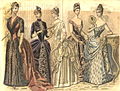
Victorian women were highly torso conscious. They wore corsets to reduce their waistline, and bustles that magnified their buttocks.[78]
-

During the 1920s, women aimed to hide their curves, bobbed their hair and wore bold makeup.[78] The feminine ideal was no longer "frail and sickly" like in the Victorian era, and so women danced and did sports.[79]
-
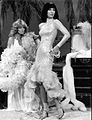
Farrah Fawcett and Cher in 1976. From the 1960s up to the 1980s, women aimed to look skinny. Tanned skin too became popular.[78]
-

The 1980s dazzler ideal was still thin, but toned without being too muscular; thus aerobics became popular. The decade likewise epitomized over-the-acme fashion.[78]
References [edit]
- ^ a b Spade, Joan Z; Valentine, Catherine (Kay) G (2010). The Kaleidoscope of Gender: Prisms, Patterns and Possibilities (3rd ed.). SAGE Publications, Inc. ISBN978-1412979061.
- ^ Thesander, Marianne (1997). The Feminine Platonic. London: Reaktion Books Ltd. pp. xx–25. ISBN978-1861890047.
- ^ a b Fayemi, Ademola Kazeem (Feb 2020). "Is skin bleaching a moral wrong? An African bioethical perspective". Theoretical Medicine and Bioethics. 41 (one): 1–22. doi:ten.1007/s11017-020-09520-1. ISSN 1386-7415. PMID 32304014. S2CID 215810349.
- ^ a b Kyo, Cho; Selden, Kyoko (2015). "Selections from The Search for the Beautiful Woman: A Cultural History of Japanese and Chinese Beauty". Review of Japanese Culture and Society. 27 (1): 184–190. doi:10.1353/roj.2015.0022. ISSN 2329-9770. S2CID 191818320.
- ^ Miller, Laura (2020-05-25). "Deracialisation or Body Mode? Cosmetic Surgery and Torso Modification in Japan". Asian Studies Review. 45 (2): 217–237. doi:x.1080/10357823.2020.1764491. ISSN 1035-7823. S2CID 219735682.
- ^ a b Henley, David; Porath, Nathan (2021-04-03). "Trunk Modification in East Asia: An Introduction". Asian Studies Review. 45 (2): 189–197. doi:10.1080/10357823.2021.1902931. ISSN 1035-7823. S2CID 233873583.
- ^ a b c d e Kim, Sunwoo; Lee, Yuri (2018-08-03). Manalo, Emmanuel (ed.). "Why do women desire to be beautiful? A qualitative study proposing a new "human beauty values" concept". PLOS Ane. 13 (8): e0201347. Bibcode:2018PLoSO..1301347K. doi:10.1371/journal.pone.0201347. ISSN 1932-6203. PMC6075765. PMID 30074991.
- ^ McH., B.; Calinescu, Matei (1988). "Five Faces of Modernity: Modernism, Avant-Garde, Decadence, Kitsch, Postmodernism". Poetics Today. 9 (three): 669. doi:10.2307/1772739. JSTOR 1772739.
- ^ "Unrealistic Beauty Standards: Korea's Cosmetic Obsession". Seoulbeats. 26 March 2015.
- ^ "We need to stop chasing unrealistic beauty standards in Asia and start feeling beautiful". CNA Lifestyle.
- ^ Stevenson, Alexandra (23 November 2018). "Due south Korea Loves Plastic Surgery and Makeup. Some Women Desire to Change That". The New York Times.
- ^ Lee, Soohyung; Ryu, Keunkwan (2012). "Plastic Surgery: Investment in Human Capital letter or Consumption?". Journal of Human Capital. 6 (3): 224–250. doi:ten.1086/667940. ISSN 1932-8575. S2CID 153765688.
- ^ a b Sharon Heijin Lee (2016). "Beauty Between Empires: Global Feminism, Plastic Surgery, and the Trouble with Self-Esteem". Frontiers: A Journal of Women Studies. 37 (1): 1. doi:x.5250/fronjwomestud.37.ane.0001. ISSN 0160-9009. S2CID 148179568.
- ^ a b Stone, Zara (2013-05-24). "The Grand-Pop Plastic Surgery Obsession". The Atlantic . Retrieved 2021-03-25 .
- ^ a b c d e "Anorexia craze amidst Korean girls raises concerns". KBR (in Korean). 2019-10-02. Retrieved 2021-12-03 .
- ^ Prusaczyk, Eastward.; Choma, B. (2016). ""Fair and Lovely:" Self-objectification, Skin Tone Surveillance, and Skin Bleaching". Personality and Individual Differences. 101: 507. doi:x.1016/j.paid.2016.05.265.
- ^ Gay, Lorenza (2016). "Gold, Reddish and Ivory: The Ideal Female Beauty and its Material Culture in 16th Century Italy and France" (PDF). Acta Academiae Artium Vilnensis (fourscore–81): 35–41.
- ^ "Les standards de beauté féminine de 8 pays décryptés". CNEWS (in French).
- ^ Lentz, Cheyenne. "ix major differences between French and American beauty". Insider.
- ^ "Les nouveaux codes de la beauté". Le Monde.fr (in French). 10 February 2012.
- ^ "Obesity and African Americans - the Office of Minority Wellness".
- ^ Watson, Laurel; Lewis, Jioni (2019). "A sociocultural exam of body image among Black women". Body Paradigm. 31: 280–287. doi:10.1016/j.bodyim.2019.03.008. PMID 30962149. S2CID 104294879.
- ^ Lowy, Alice S. (2021). "Trunk epitome and internalization of appearance ideals in Black women: An update and phone call for culturally-sensitive enquiry". Body Paradigm. 39: 313–317. doi:10.1016/j.bodyim.2021.10.005. PMID 34749264. S2CID 243825020.
- ^ a b Gentles-Peart, Kamille (2021). "Bumpah politics: The thick Black female body in Us and Caribbean area academic discourses". The Routledge Companion to Dazzler Politics. Routledge. pp. 177–185. doi:ten.4324/9780429283734-21. ISBN9781000413618. S2CID 240773647.
- ^ Gentles-Peart, Kamille (2016). Romance with Voluptuousness: Caribbean area Women and Thick Bodies in the United States. University of Nebraska Press. ISBN9780803290808.
- ^ "The Kardashians' Legacy of Blackfishing and Cribbing | Time".
- ^ Makkar, Jalmeen Chiliad.; Strube, Michael J. (1995). "Black Women'southward Cocky-Perceptions of Bewitchery Post-obit Exposure to White Versus Black Dazzler Standards: The Moderating Role of Racial Identity and Self-Esteem". Journal of Practical Social Psychology. 25 (17): 1547–1566. doi:10.1111/j.1559-1816.1995.tb02632.x. ISSN 1559-1816.
- ^ Wilder, JeffriAnne (2015-10-26). Color Stories: Blackness Women and Colorism in the 21st Century: Black Women and Colorism in the 21st Century. ABC-CLIO. ISBN978-1-4408-3110-2.
- ^ a b c d Balcetis, Due east.; Cole, South.; Chelberg, Grand. B.; Alicke, Yard. (2013). "Searching out the ideal: Awareness of ideal body standards predicts lower global cocky-esteem in women". Self and Identity. 12 (1): 99–113. doi:10.1080/15298868.2011.639549. S2CID 143048134.
- ^ Hunter, Margaret (2007). "The Persistent Trouble of Colorism: Pare Tone, Status, and Inequality". Sociology Compass. 1 (1): 237–254. doi:10.1111/j.1751-9020.2007.00006.x. ISSN 1751-9020.
- ^ Drupe, D. Channsin; Duke, Nib (2011-09-14), Dark Girls (Documentary), Soren Baker, Ronald Boutelle, Joni Bovill, Kirk Bovill, Knuckles Media, Urban Winter Entertainment, retrieved 2020-xi-02
- ^ Engel, Laura (2018), Jones, Emrys D.; Joule, Victoria (eds.), "Epilogue: Body Double—Katharine Hepburn at Madame Tussauds", Intimacy and Celebrity in Eighteenth-Century Literary Culture: Public Interiors, Cham: Springer International Publishing, pp. 293–298, doi:10.1007/978-iii-319-76902-8_13, ISBN978-three-319-76902-eight , retrieved 2020-11-02
- ^ Tran, Alison; Rosales, Robert; Copes, Lynn (2020-04-01). "Paint a Better Mood? Furnishings of Makeup Use on YouTube Beauty Influencers' Self-Esteem". SAGE Open up. 10 (2): 2158244020933591. doi:10.1177/2158244020933591. ISSN 2158-2440. S2CID 220928885.
- ^ Marway, Herjeet (2018-09-01). "Should We Genetically Select for the Beauty Norm of Fair Skin?". Health Care Analysis. 26 (3): 246–268. doi:10.1007/s10728-017-0341-y. ISSN 1573-3394. PMC6061025. PMID 28324196.
- ^ a b Mishra, Neha (2015). "India and Colorism: The Effectively Nuances". Global Studies Constabulary Review. 14.
- ^ a b c d Adbi, Arzi; Chatterjee, Chirantan; Cortland, Clarissa; Kinias, Zoe; Singh, Jasjit (2021). "Women'south Disempowerment and Preferences for Skin Lightening Products That Reinforce Colorism: Experimental Prove From Bharat". Psychology of Women Quarterly. 45 (ii): 178–193. doi:10.1177/0361684321993796. ISSN 0361-6843. S2CID 233964203.
- ^ a b c Das, Madhusmita; Sharma, Sangeeta. "Fetishizing Women: Advertizement in Indian Television and its Furnishings on Target Audiences". Retrieved 2021-12-09 .
{{cite web}}: CS1 maint: url-condition (link) - ^ Hussein, Nazia (2010). "Color of Life Achievements: Historical and Media Influence of Identity Formation Based on Peel Color in Southern asia". Journal of Intercultural Studies. 31 (4): 403–424. doi:ten.1080/07256868.2010.491275. ISSN 0725-6868. S2CID 145263423.
- ^ a b c Maycock, Matthew William (2017-04-03). "Looking tājā 'fresh'; skin whitening, and emergent masculinities in far-due west Nepal". Gimmicky South asia. 25 (2): 153–166. doi:ten.1080/09584935.2017.1321619. ISSN 0958-4935. S2CID 151955288.
- ^ a b c Kukreja, Reena (2021). "Colorism as Marriage Uppercase: Cross-Region Wedlock Migration in India and Dark-Skinned Migrant Brides". Gender & Guild. 35 (1): 85–109. doi:10.1177/0891243220979633. ISSN 0891-2432. S2CID 231840988.
- ^ Heubeck, Girls and Body Prototype: Media's Event, How Parents Can Help. WebMD. Retrieved October 26, 2013.
- ^ Dittmar, H.; Halliwell, Eastward.; Ive, Southward. (2006). "Does Barbie make girls want to be thin? The result of experimental exposure to images of dolls on the body paradigm of 5- to 8-twelvemonth-sometime girls" (PDF). Developmental Psychology. 42 (two): 283–292. CiteSeerXten.1.ane.535.9493. doi:ten.1037/0012-1649.42.2.283. PMID 16569167. Archived from the original (PDF) on 2018-12-xvi. Retrieved 2019-01-09 .
- ^ White, Michele (2009). "Networked bodies and extended corporealities: Theorizing the human relationship betwixt the trunk, embodiment, and contemporary new media". Feminist Studies.
- ^ Kosut, Mary (2012). Encyclopedia of Gender in Media. Thousand Oaks, Calif.: SAGE Publications, Inc. 2012. pp. sixteen–17.
- ^ Groesz, L. Chiliad.; Levine, M. P.; Murnen, S. K. (2002). "The issue of experimental presentation of thin media images on body satisfaction: A meta-analytic review". International Journal of Eating Disorders. 31 (1): 1–16. doi:x.1002/eat.10005. PMID 11835293.
- ^ a b Swami, Viren; Coles, Rebecca; Wilson, Emma; Salem, Natalie; Wyrozumska, Karolina; Furnham, Adrian (2010). "Oppressive Beliefs at Play: Associations Among Beauty Ideals and Practices and Private Differences in Sexism, Objectification of Others, and Media Exposure". Psychology of Women Quarterly. 34 (3): 365–379. doi:10.1111/j.1471-6402.2010.01582.ten. ISSN 1471-6402. OCLC 985114735. S2CID 143388437.
- ^ "New Dove Inquiry Finds Beauty Pressures Up, and Women and Girls Calling for Change". CISION PR Newswire. PR Newswire. Retrieved January 9, 2019.
- ^ "Our Inquiry". Dove. Dove. Retrieved January 9, 2019.
- ^ a b c d e f Tiggemann, Marika; Zaccardo, Mia (2016). "'Stiff is the new skinny': A content assay of #fitspiration images on Instagram". Journal of Health Psychology. 23 (viii): 1003–1011. doi:10.1177/1359105316639436. ISSN 1359-1053. OCLC 967845901. PMID 27611630. S2CID 5115417.
- ^ Fardouly, Jasmine; Willburger, Brydie K.; Vartanian, Lenny R. (February 2017). "Instagram use and young women's body image concerns and self-objectification: Testing mediational pathways". New Media & Guild. 20 (4): 1380–1395. doi:10.1177/1461444817694499. ISSN 1461-4448. OCLC 852641454. S2CID 4953527.
- ^ a b c d Caldeira, Sofia P.; De Ridder, Sander (2017). "Representing diverse femininities on Instagram: A case written report of the body-positive @effyourbeautystandards Instagram account". Catalan Journal of Advice & Cultural Studies. 9 (2): 321–337. doi:10.1386/cjcs.9.2.321_1. ISSN 1757-1898. OCLC 967845901.
- ^ a b c Baker-Sperry, L.; Grauerholz, L. (2003). "The pervasiveness and persistence of the feminine beauty ideal in children's fairy tales". Gender & Society. 17 (5): 711–726. doi:x.1177/0891243203255605. S2CID 54711044.
- ^ Grimm, J. & Grimm, Due west. (1857). Snow White. Berlin: Children's and Household Tales.
- ^ "Unrealistic anatomies of Disney princesses revealed". NY Daily News . Retrieved January 9, 2019.
- ^ Ussher, Jane M.; Hawkey, Alexandra; Perz, Janette; Liamputtong, Pranee; Sekar, Jessica; Marjadi, Brahmaputra; Schmied, Virginia; Dune, Tinashe; Brook, Eloise (2020-08-12). "Crossing Boundaries and Fetishization: Experiences of Sexual Violence for Trans Women of Color". Journal of Interpersonal Violence. 37 (v–vi): NP3552–NP3584. doi:x.1177/0886260520949149. ISSN 0886-2605. PMID 32783523. S2CID 221125930.
- ^ a b Lovelock, Michael (2017-eleven-02). "Call me Caitlyn: making and making over the 'authentic' transgender torso in Anglo-American pop civilisation". Periodical of Gender Studies. 26 (6): 675–687. doi:10.1080/09589236.2016.1155978. ISSN 0958-9236. S2CID 147419288.
- ^ a b Carretta, Rachel F.; Szymanski, Dawn Yard.; DeVore, Elliott (2019-09-01). "Predictors of disordered eating and acceptance of cosmetic surgery amidst elevate queen performers". Body Image. thirty: 64–74. doi:ten.1016/j.bodyim.2019.05.006. ISSN 1740-1445. PMID 31174082. S2CID 182950149.
- ^ "(1006)". libraryguides.missouri.edu . Retrieved 2022-04-24 .
- ^ a b c d Fitts, Yard. & O'Brien, J. (2009). Trunk image. In Encyclopedia of Gender and Club. (pp. 82–87). Thou Oaks, CA: SAGE Publications.
- ^ Renzetti, C. Thousand., Curran, D. J., & Maier, South. L. (2012). Women, men, and club (sixth ed.). Pearson.
- ^ Cash, T. F.; Morrow, J. A.; Hrabosky, J. I.; Perry, A. A. (2004). "How has body prototype changed? A cross-sectional investigation of college women and men from 1983 to 2001" (PDF). Journal of Consulting and Clinical Psychology. 72 (6): 1081–1089. doi:x.1037/0022-006x.72.6.1081. PMID 15612854.
- ^ Jefferson, D. L.; Pale, J. Eastward. (2009). "Advent self-attitudes of African American and European American women: Media comparisons and internalization of beauty ethics". Psychology of Women Quarterly. 33 (four): 396–409. doi:10.1111/j.1471-6402.2009.01517.x. S2CID 144320322.
- ^ Mazur, Allen (August 1986). "U.S. Trends in Feminine Beauty and Overadaptation" (PDF). The Journal of Sex Research. 22 (3): 281–303. doi:10.1080/00224498609551309. Archived from the original (PDF) on 2017-08-11. Retrieved 2018-04-23 .
- ^ Jackson, 50. A. (1992). Concrete advent and gender: Sociobiological and sociocultural perspectives. Albany, NY: Country University of New York Press.
- ^ a b c Owen, P. R.; Laurel; Seller, East. (2000). "Weight and shape ideals: Sparse is dangerously in". Journal of Practical Social Psychology. xxx (5): 979–990. doi:10.1111/j.1559-1816.2000.tb02506.ten. ISSN 1559-1816. OCLC 66791717.
- ^ Serdar, K. Fifty. (2011). Female body epitome and the mass media: Perspectives on how women internalize the platonic dazzler standard. Westminster Higher. Westminster Coll., nd Spider web.
- ^ "Her Life Depends On It II" (PDF). Archived from the original (PDF) on 2010-06-16. Retrieved 2020-11-02 .
- ^ "Barbie sales Mattel worldwide 2020". Statista . Retrieved 2021-11-22 .
- ^ Jellinek, Rebecca D.; Myers, Taryn A.; Keller, Kathleen Fifty. (2016-09-01). "The impact of doll style of dress and familiarity on body dissatisfaction in vi- to 8-yr-old girls". Body Image. xviii: 78–85. doi:10.1016/j.bodyim.2016.05.003. ISSN 1740-1445. PMID 27344610.
- ^ a b Maine, Margo (18 October 2013). Body wars: making peace with women's bodies: an activist's guide. ISBN978-0-936077-34-5. OCLC 43430350.
- ^ "BMI - Body Mass Alphabetize | SkillsYouNeed". www.skillsyouneed.com . Retrieved 2021-eleven-22 .
- ^ American Addiction Centre. "Dying to be Barbie | Eating Disorders in Pursuit of the Impossible". National Rehab Directory.
{{cite web}}: CS1 maint: url-status (link) - ^ Singh, Devendra; Singh, Dorian (2011). "Shape and Significance of Feminine Beauty: An Evolutionary Perspective". Sex Roles. 64 (9–10): 723–731. doi:ten.1007/s11199-011-9938-z. S2CID 144644793.
- ^ Singh, D.; Renn, P.; Singh, A. (2007). "Did the perils of abdominal obesity bear upon delineation of feminine beauty in the sixteenth to eighteenth century British literature? Exploring the health and beauty link". Proceedings of the Royal Guild B: Biological Sciences. 274 (1611): 891–894. doi:x.1098/rspb.2006.0239. PMC2093974. PMID 17251110.
- ^ a b Bovet, Jeanne (2019-06-04). "Evolutionary Theories and Men's Preferences for Women's Waist-to-Hip Ratio: Which Hypotheses Remain? A Systematic Review". Frontiers in Psychology. 10: 1221. doi:10.3389/fpsyg.2019.01221. ISSN 1664-1078. PMC6563790. PMID 31244708.
- ^ Wenzlaff, Frederike; Briken, Peer; Dekker, Arne (2018-03-01). Pellis, Sergio (ed.). "If in that location's a penis, it's nigh likely a man: Investigating the social structure of gender using middle tracking". PLOS ONE. thirteen (3): e0193616. Bibcode:2018PLoSO..1393616W. doi:10.1371/journal.pone.0193616. ISSN 1932-6203. PMC5832313. PMID 29494689.
- ^ M. Kiss, David (2019). Evolutionary Psychology. Taylor & Francis. pp. 130–139.
- ^ a b c d east "A Timeline of Sexy Defined Through the Ages". Discovery News. StyleCaster. March 19, 2010. Retrieved January 9, 2019.
- ^ a b "The Ideal Woman Through the Ages: Photos". Discovery News. Discovery Communications. December 12, 2012. Archived from the original on May 17, 2016. Retrieved January 9, 2019.
Source: https://en.wikipedia.org/wiki/Feminine_beauty_ideal
Posted by: adamsdonest.blogspot.com
0 Response to "How Much Do Girls Waist On Makeup Statistics"
Post a Comment